

Stop managing your tools.Start doing actual work.
There's a moment every knowledge worker knows.
You finish a meeting. Everyone nods. Someone says "let's follow up on this." And then you open six different apps trying to figure out who said what, what was decided, and who is actually supposed to do the thing that was supposed to happen.
By the time you've found the Slack thread, opened Asana, searched Google Drive, and written the summary email, thirty minutes have gone. And you haven't done a single minute of actual work.
What We Kept Hearing
We spent weeks going through forums, communities, and conversations with working professionals. Not to validate our idea. To understand the problem. What we heard was consistent, and it was human:
"Devs side-slacking me... piecing it all together at 11pm."
"The worst offender: just checking Slack/Email..."
"Busy for 8 hours but nothing meaningful gets done."
"Tools running the team, not the other way around."
The frustration wasn't with any single tool. People have gotten good at using Slack. They know how to use Asana. The frustration was with what happens between them: the manual coordination, the context that gets lost in translation, the invisible work of stitching everything together.
Studies put a number on it. Employees lose between 45 and 90 minutes every single day to this kind of work sprawl. For a 100-person company, that's roughly $420,000 a year in productivity that quietly bleeds out.








The Idea
We didn't want to build another tool. The last thing anyone needs is another app in the stack. We were very clear about that from the beginning. Instead, we asked: What if there was something that lived above all the tools? Something that understood what was happening across all of them, and quietly made sure things got done?
Not a chatbot. Not a dashboard. Not an integration platform. Gaprio acts as a very sharp colleague, an interactive neural mesh, that reads conversations, attends meetings, and always knows exactly what needs to happen next.
How It Actually Works
The best way to explain Gaprio is through what currently doesn't happen automatically.
Scenario
A manager drops a message in Slack: "Can someone draft the proposal for the Kapoor account before Friday?"
Right now: someone creates a task in Asana (maybe), someone else searches Drive for the last proposal, someone emails the client for context, someone sets a reminder, and on Thursday afternoon someone realizes nobody actually started writing it.
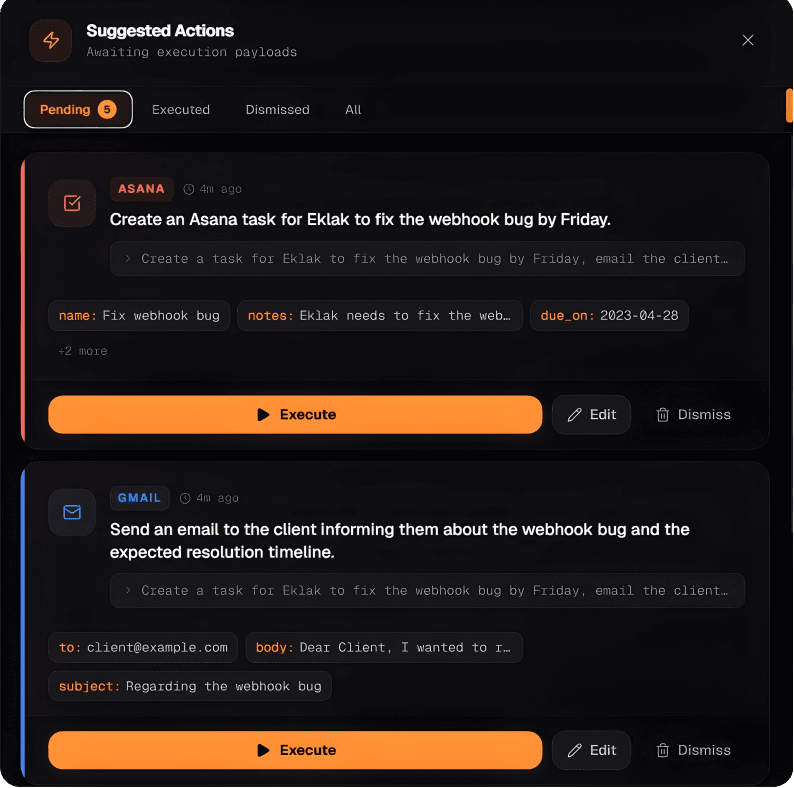
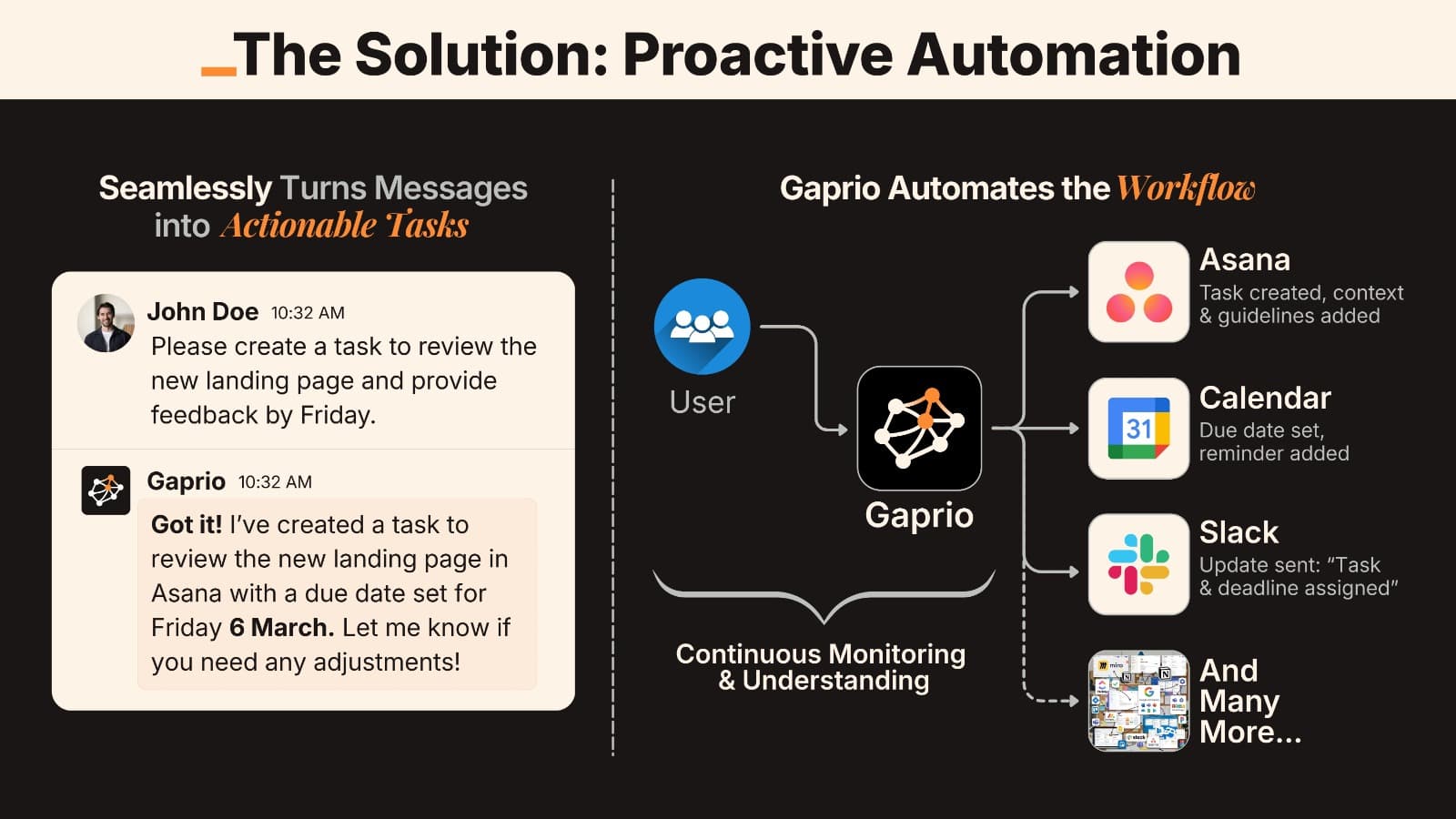
With Gaprio: The system reads the Slack message. It understands that this is a formal deliverable, with a deadline, tied to a client. It pulls up the last proposal from Drive, identifies who on the team has worked on similar documents before, and surfaces a single notification:
"Proposal detected for Kapoor account. Should I create the task, assign it, and generate a first draft using your previous proposal as reference?"
One click. Gaprio creates the task, generates the draft in Google Docs, and notifies the right person, all within the tools already being used. The 45 minutes of coordination work just didn't happen.
What Makes It Different
We know what you're thinking. Asana has integrations. ClickUp connects to everything. Microsoft Copilot is already inside Teams.
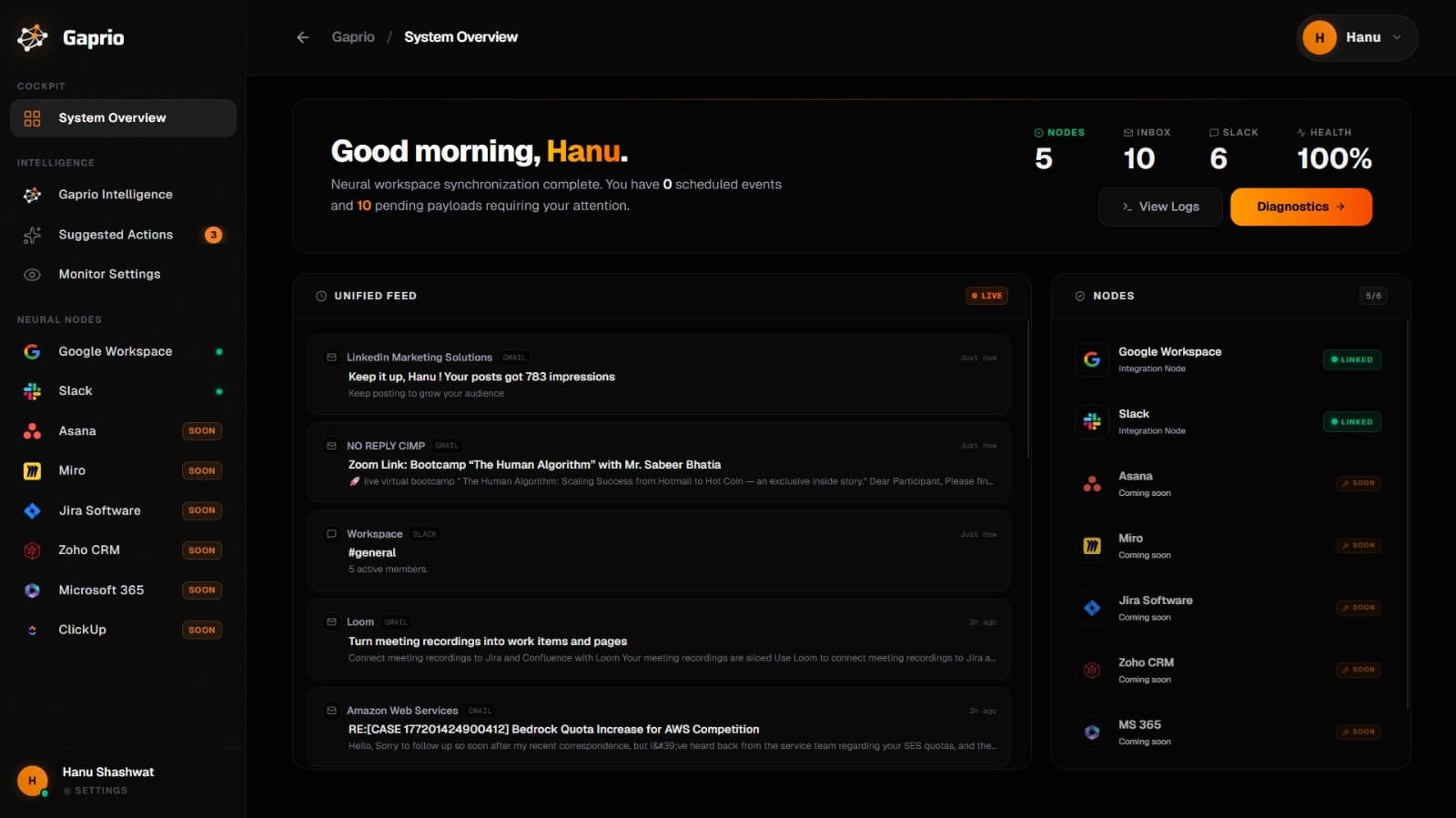
Those tools connect apps. They push data from one place to another. They let you see your Slack messages inside Asana. Gaprio doesn't move data. It understands context.
It knows that the Slack message about "the Kapoor proposal" is the same project as Task #4821 in Asana, the same client as the folder in Drive, and the same deadline discussed in Tuesday's meeting. No other tool builds that picture, because no other tool was designed to.
Who This Is For
Gaprio is built for organizations where coordination is the invisible job that everyone does and nobody accounts for.
If you manage a team across multiple tools and regularly find yourself either chasing updates or being the person who "just keeps track of everything", Gaprio is built around your problem.
What We're Asking
We're running our first wave of market validation. We are talking to operations leaders, product managers, and experienced founders. We're not asking you to switch tools. Let's have a quick chat to see if we can solve your biggest operational headache.